India may generate huge amounts of photovoltaic module waste by 2030
Quick answer: A 5KW solar system of this configuration produces about 33.6KWH per day from 16x350W monocrystalline panels and driven by a 5KW/7KVA inverter. Built by Mars Solar (factory since 2008), CE/ROHS certified, 25-year panel life, shipped factory-direct to 130+ countries.
India's solar installed capacity growth forecast by 2030 also means that a large amount of photovoltaic module waste will accumulate due to early failure or damage during transportation, installation and operation. Assuming that India’s cumulative installed photovoltaic capacity will increase from 40 GW in 2020 to 287.4 GW in 2030, the total waste generated may reach 21 kilotons. This does not include scrapped panel waste, because the Solar Power Complete System installed during 2020-30 is assumed to have a service life of at least thirty years.
If India’s installed solar capacity increases from 40 GW in 2020 to 287 GW by 2030, India may generate 21 kilotons of photovoltaic module waste. According to a new study, early failures or damages during transportation, installation, and operation are all causes of these photovoltaic wastes. The report was prepared in cooperation with the European Union and India Technical Cooperation Project (IDOM), the European solar energy industry trade body SolarPower Europe, the European Recycling and Recycling Association PV Cycle, and the National Solar Energy Federation of India (NSEFI).
In order to predict how much photovoltaic waste India will generate by 2030, the researchers estimated the annual and cumulative growth of India's photovoltaic installed capacity under three scenarios. In addition, they made assumptions about the weight of photovoltaic modules, the annual replacement rate of photovoltaic modules, and the damage of photovoltaic modules during transportation and construction.
They found that by 2030, India will produce a total mass of 11 kilotons ("low level scenario") / 21 kilotons (medium level scenario) / 34 kilotons ("high level scenario") of photovoltaic module waste. The waste generated with the end of the life of photovoltaic modules may begin to accumulate after 2040 and will quickly become the most influential source of waste.
Compared with the current installation level, the annual photovoltaic market is expected to grow substantially under all three hypothetical scenarios investigated in this research. By 2030, the cumulative installed capacity under all scenarios has experienced several-fold growth. From the basis of only 40 GW in 2020, under low and medium-level scenarios, the cumulative capacity by 2030 will reach 187 GW and 287 GW respectively, while in high-level scenarios, it is expected to reach the ambitious government proposed by 2030. Target of 400 GW. Assuming that the photovoltaic system installed during 2020-30 has a service life of at least 30 years, then all installed capacity installed during this period will not reach the end of life stage until at least 2050.
Given that ground-mounted solar energy constitutes the vast majority of photovoltaic installed capacity, and residential buildings account for only a small part of rooftop installations, this report concludes that scrap photovoltaic waste will mainly come from the B2B sector.
-
 6MW 20MWh Solar Storage in Nigeria Factory + Farm + Residential Case StudyA 6MW solar PV + 20MWh LFP battery storage system in Nigeria powers an integrated factory, farm, and residential complex. The system delivers $108,000+ in monthly electricity savings, reaches payback in approximately 24 months, and provides 25 years of renewable power. This case study covers the engineering configuration, financial model, and operational performance of one of West Africa's most ambitious factory + farm + residential solar deployments.
Do you like ?0
Read more -
 Solar Panel Shipping & Container Loading: The 2026 Complete GuideThe solar panels leaving the factory are perfect. By the time they arrive at your warehouse, 3–7% might be damaged, delivery could be 2 weeks late, and demurrage at the destination port could wipe out your margin. This 2026 guide covers container types (2
Do you like ?0
Read more -
 Solar Panel Factory Verification: The 7-Step Due Diligence GuideEvery year, international solar buyers lose millions to fraudulent suppliers — fake certificates, empty factories, and panels that don't match spec. This 7-step verification guide shows you exactly how to qualify any China solar factory before you wire mo
Do you like ?0
Read more -
 Solar Panel MOQ, Lead Time & Payment Terms: The Complete 2026 Buyer's GuideMOQ, lead time, and payment terms are the 3 questions every solar buyer asks — and the 3 answers most suppliers hide behind vague emails. This guide gives you complete, honest answers from a verified China factory with 17+ years and 3,000+ export projects
Do you like ?0
Read more -
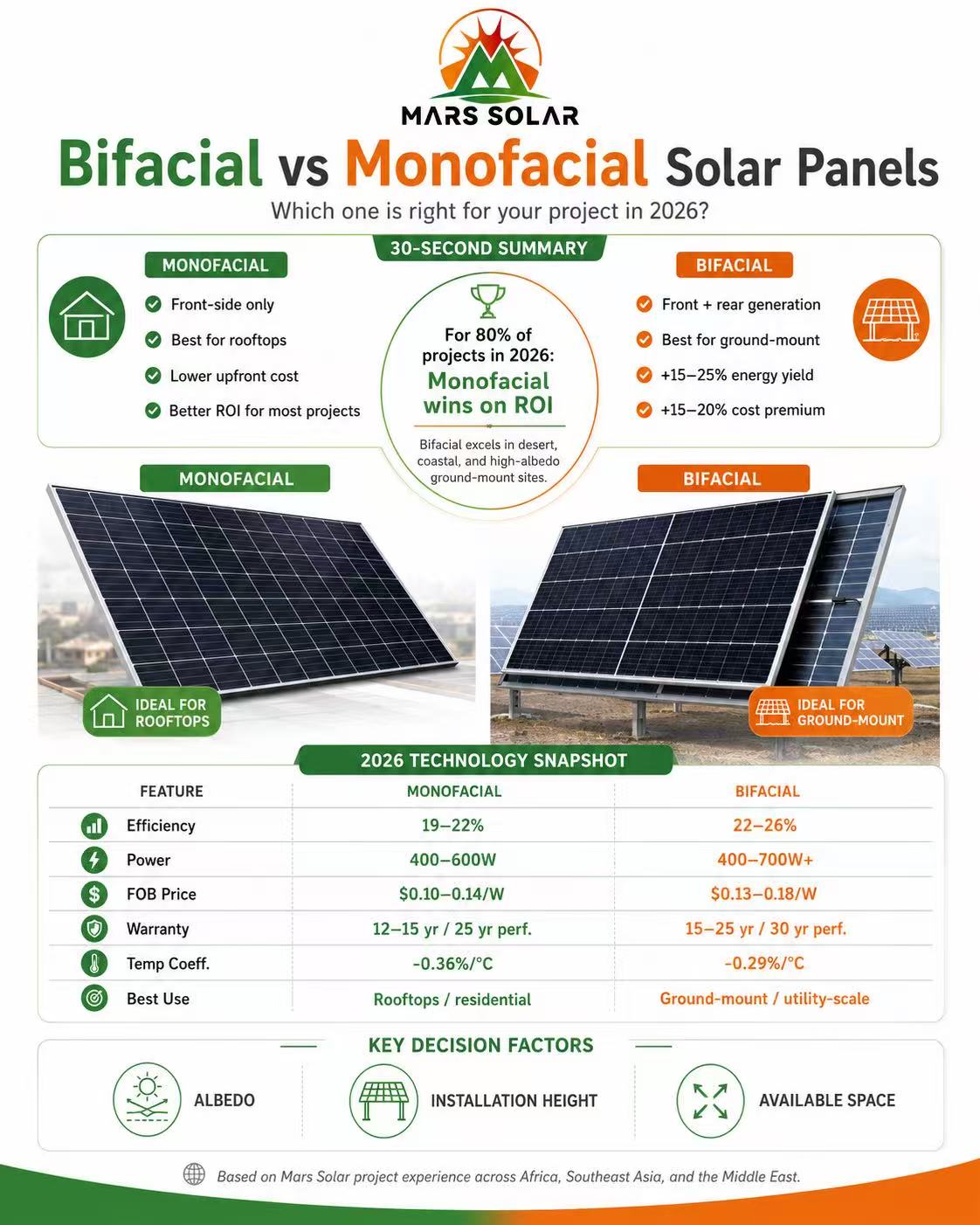 Solar Panel Selection Guide: Monofacial vs. Bifacial — 2026 EditionMonofacial and bifacial solar panels look identical but deliver 15-25% output difference. This 2026 guide compares 15 technical parameters, analyzes 5 real project ROI cases (Nigeria, Philippines, Ghana, Kenya, DRC), and gives you 3 decision frameworks to
Do you like ?0
Read more -
 Top 10 Solar Panel Manufacturers China 2026 | Best BrandsDiscover the top 10 solar panel manufacturers China 2026. Compare Jinko, LONGi, Trina & more. Find Tier 1 suppliers.
Do you like ?0
Read more