Nigeria Solar by Supply Band: What Band A to E Customers Actually Pay
Every solar quote for Nigeria starts with the wrong number. It starts with the tariff on your bill.
That number is almost never what you pay per usable kilowatt-hour, because the grid does not deliver the hours your band promises, and a generator fills whatever is missing. A Band E feeder billed at ₦40/kWh sounds cheap until you price in the plant that runs eighteen hours a day. A Band A feeder at ₦209.5/kWh looks expensive until you notice it is roughly half the cost of the diesel it displaces.
So the comparison that decides a Nigeria solar supply band decision is not tariff versus tariff. It is what each band actually costs once you add the generator hours required to keep the lights on. This guide walks through the five NERC bands, converts each into a real blended cost per kilowatt-hour, and shows what battery capacity that implies for your site.
Quick answer: what does electricity really cost per band in Nigeria?
A Nigerian commercial site on Band A pays about ₦209.5/kWh to the grid and roughly ₦429/kWh for every unit a diesel generator covers. Sites on Bands B to E pay a lower grid rate — approximately ₦63, ₦50, ₦45 and ₦40 — but receive far fewer guaranteed hours, so a larger share of their consumption falls on the generator. The blended cost is what matters for any Nigeria solar supply band calculation, and for most commercial sites it lands well above the Band A headline rate.
How NERC's five bands actually work for Nigeria solar
NERC sorts distribution feeders into five bands by the number of hours of supply they deliver each day. Your band is a property of the feeder serving your area, not something you choose, and it is the starting point for sizing storage in Nigeria.
| Band | Guaranteed supply | Indicative grid rate |
|---|---|---|
| A | 20+ hours/day | ₦209.5/kWh |
| B | 16–20 hours/day | ~₦63/kWh |
| C | 12–16 hours/day | ~₦50/kWh |
| D | 8–12 hours/day | ~₦45/kWh |
| E | 4–8 hours/day | ~₦40/kWh |
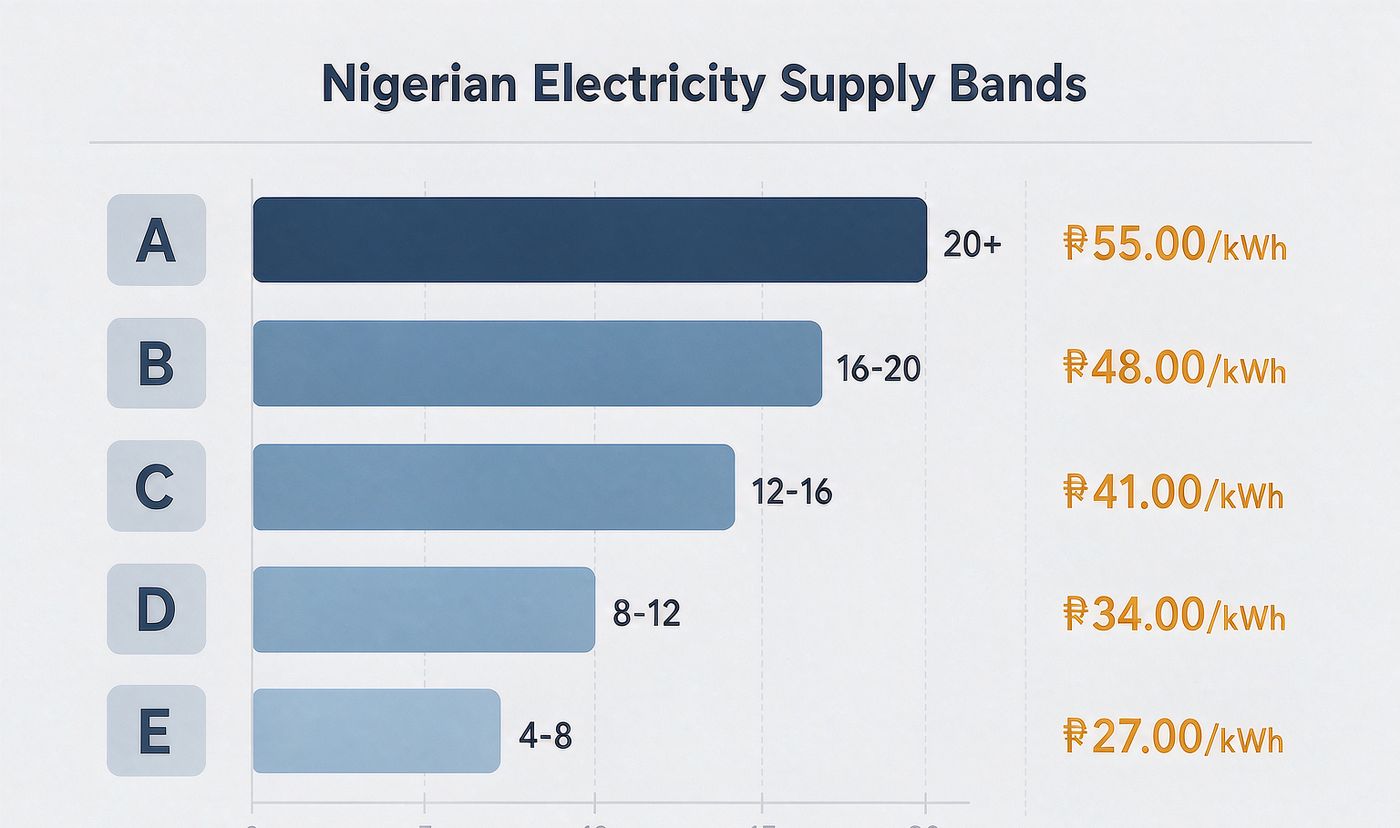
Two things about this table catch buyers out.
First, Band A is the only fully cost-reflective band. Bands B through E are subsidised, which is why their headline rates are a fraction of Band A. That subsidy is real money — NERC put the cost of the frozen tariff structure at roughly ₦1.928 trillion, about USD 1.45 billion, in its 2025 industry report.
Second, ₦209.5 is the rate for ten of the eleven distribution companies. Enugu Electricity Distribution Company is the exception at about ₦160/kWh on Band A.
The EEDC exception matters more than it looks
If your site is in Enugu, Anambra, Abia, Imo or Ebonyi, your Band A arithmetic is materially different, and any Nigeria solar supply band quote built on the ₦209.5 figure will overstate your savings by roughly a quarter.
Here is the full picture across the eleven DisCos on Band A, effective from late 2025:
| DisCo | Band A rate | Coverage |
|---|---|---|
| EEDC (Enugu) | ₦160.00 | Enugu, Anambra, Abia, Imo, Ebonyi |
| AEDC (Abuja) | ₦209.50 | FCT, Niger, Nasarawa, Kogi |
| BEDC (Benin) | ₦209.50 | Edo, Delta, Ondo, Ekiti |
| EKEDC (Eko) | ₦209.50 | Lagos Island, Victoria Island, Lekki, Ikoyi |
| IBEDC (Ibadan) | ₦209.50 | Oyo, Ogun, Osun, Kwara |
| IKEDC (Ikeja) | ₦209.50 | Mainland Lagos, parts of Ogun |
| JED (Jos) | ₦209.50 | Plateau, Bauchi, Gombe |
| KAEDCO (Kaduna) | ₦209.50 | Kaduna, Kebbi, Sokoto |
| KEDCO (Kano) | ₦209.50 | Kano, Katsina, Jigawa |
| PHED (Port Harcourt) | ₦209.50 | Rivers, Akwa Ibom, Bayelsa, Cross River |
| YEDC (Yola) | ₦209.50 | Adamawa, Taraba, Borno |
Bands B through E vary by distribution company too, and no single national figure is quoted for them, so treat the indicative rates as a starting point and confirm your feeder's actual classification with your DisCo.
The Nigeria solar tariff has been frozen, not rising
Band A has been held at ₦209.5 since July 2024, with the current MYTO order in force since late 2025. As of late 2026 no increase has been approved and the government has signalled no immediate plan to raise it.
This is worth stating plainly because a good deal of published material on Nigeria solar supply band pricing still describes the tariff as rising through 2025 and 2026. It is not. The rate is frozen, and the policy debate is about the subsidy cost of keeping it frozen.
The number that decides your Nigeria solar battery size
Grid rates are the wrong input. The right input is the cost of the unit you would otherwise generate yourself.
At ₦1,500 per litre, a diesel generator produces roughly ₦429 per kilowatt-hour on fuel alone, assuming about 3.5 kWh per litre. That figure excludes the generator's purchase price, servicing, and the operator who starts it every morning. Petrol generators are less fuel-efficient again, and petrol currently runs around ₦1,075 per litre.
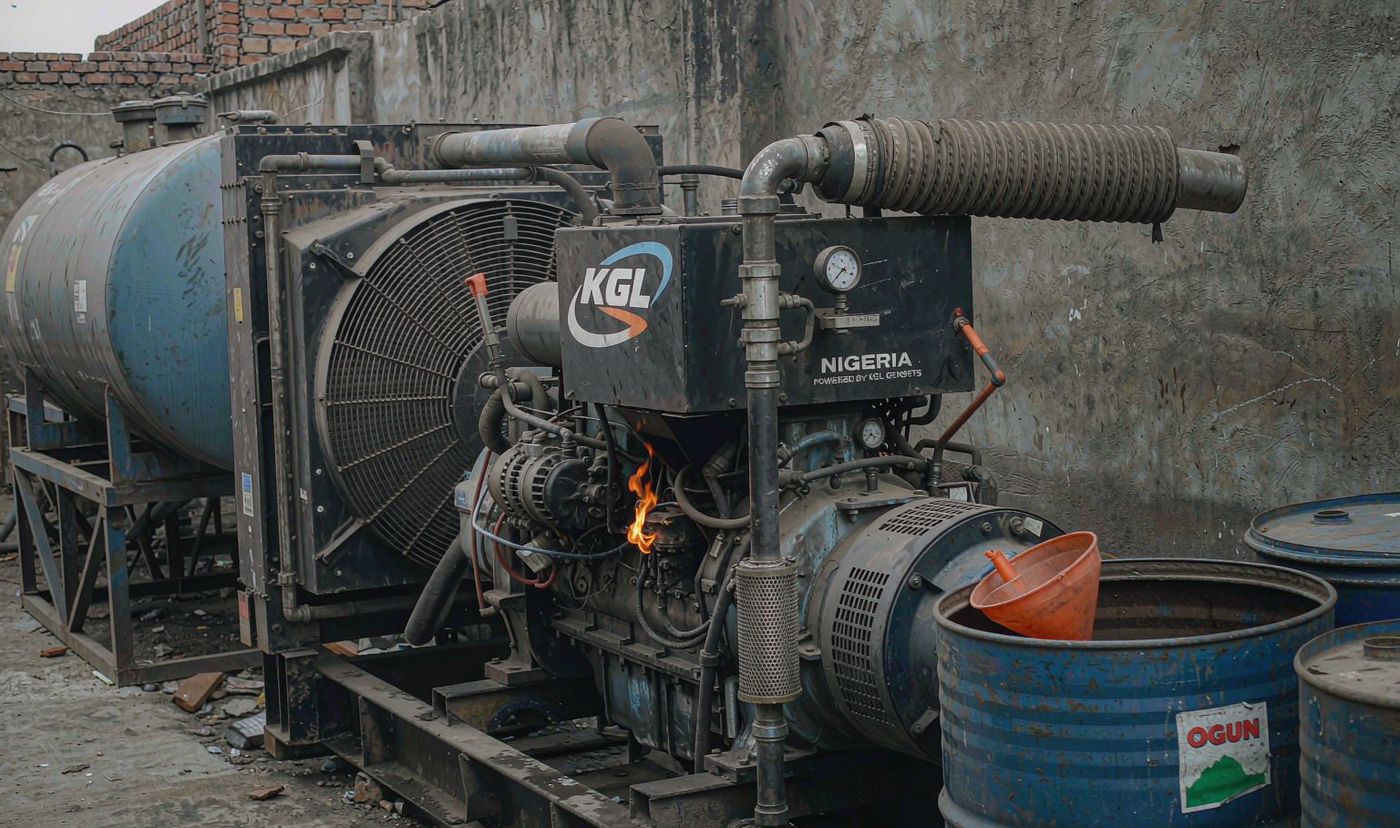
Here is what that means for a Nigeria solar supply band comparison. A Band A site pays ₦209.5 to the grid and ₦429 to the generator, so grid power is about 51 percent cheaper per unit before you count what the generator cost to buy. A Band E site pays ₦40 to the grid for maybe four to eight hours, then ₦429 for everything else. The cheap tariff applies to a small fraction of consumption.
Why blended cost beats the Nigeria solar headline tariff
Worked simply for Nigeria solar planning — a site consuming 10,000 kWh a month on Band D that receives ten hours of daily supply gets roughly 3,000 kWh from the grid and runs a generator for the remaining 7,000. At ₦45 and ₦429 respectively, that is about ₦135,000 plus ₦3,003,000 — a blended rate near ₦314/kWh, nearly eight times the headline tariff and well above what a Band A customer pays.
The lower your band, the closer your real cost moves toward the diesel figure. That is the single most useful thing to understand before you ask any supplier for a Nigeria solar supply band proposal.
This reframes what you are buying. Storage in Nigeria is not competing against a tariff. It is competing against a fuel bill, so the metric that matters for cell selection is cost per delivered kilowatt-hour over cycle life, not peak-shaving arbitrage.
What Nigeria solar Band A customers should know about the compensation directive
There is one 2026 development worth knowing before you model savings.
NERC issued Directive No. NERC/2026/002 on the special compensation of Band A customers affected by grid generation constraints, covering eligible customers who experienced shortfalls between February and March 2026. Under that framework, smaller non-maximum-demand customers were to receive a credit equal to 20 percent of the approved February 2026 energy cap for their feeder, while larger maximum-demand customers received 20 percent of the average energy billed per maximum-demand customer that month.
The significance is not the credit itself. It is that NERC has started enforcing the service obligation attached to the premium rate — the regulator's position being that customers paying a cost-reflective tariff should receive the supply they are paying for, and should be credited when they do not. That is a meaningfully different posture from the tariff system of 2022 and 2023.
For storage planning this cuts both ways. Compensation reduces the penalty for grid shortfalls, which slightly softens the arbitrage case on Band A. But it does nothing about diesel, and it does not apply to Bands B through E at all, where the reliability gap is far wider.
Sizing storage against your band
The pattern that holds across most Nigeria solar commercial sites: the fewer guaranteed hours your feeder delivers, the more of your load has to be carried by batteries overnight, and the more your economics are driven by displaced diesel rather than by tariff difference.
Band A: what a Nigeria solar buyer should cover
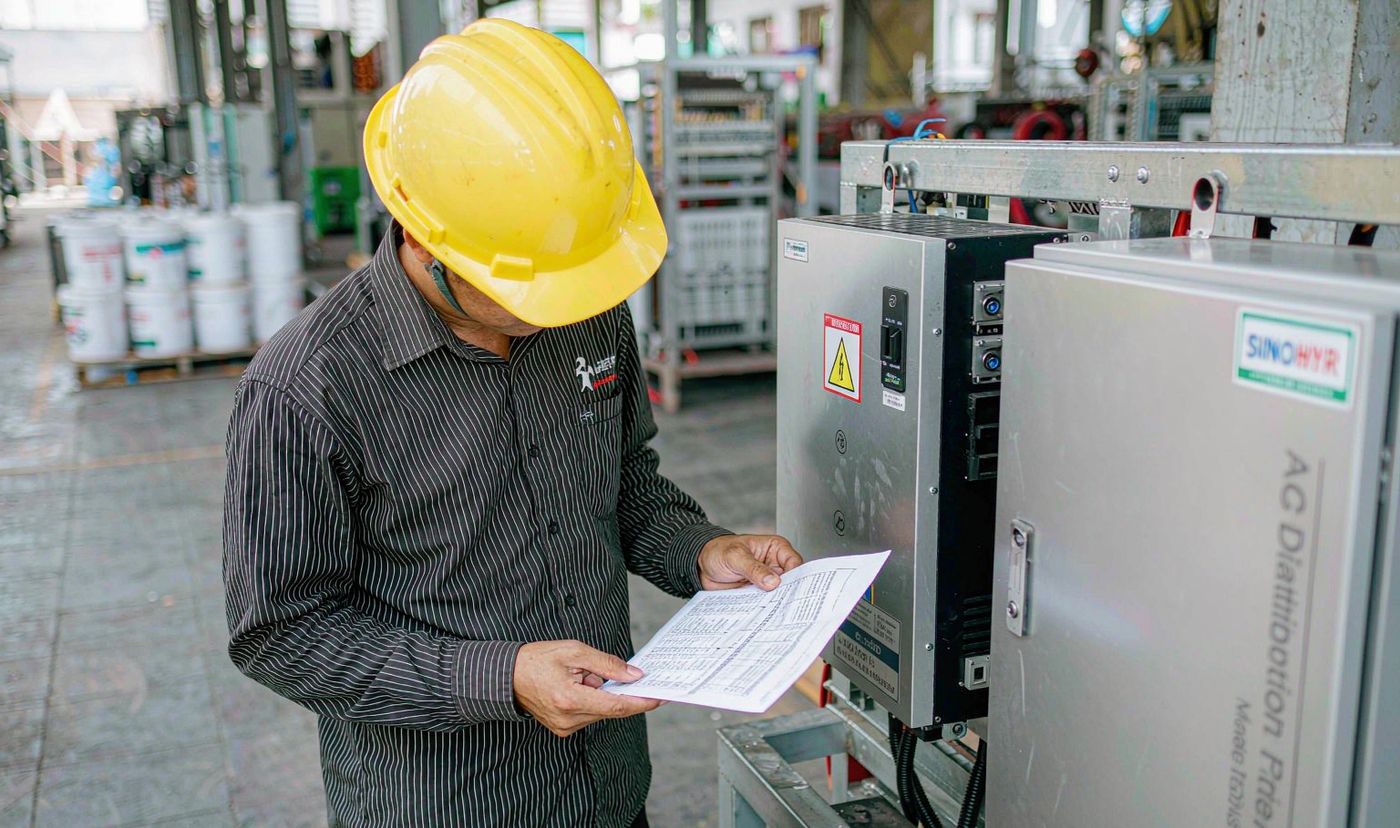
Storage mainly covers the evening peak and short outages. Battery capacity can be modest relative to load, because the grid covers most hours. The case rests on ₦429 diesel avoidance during interruptions, not on the ₦209.5 versus ₦63 spread between bands.
Bands B and C: bridging the working day with Nigeria solar storage
The grid covers a working day but not a full one. Storage bridges the gap between grid availability and your operating hours, and sizing should follow your evening load profile rather than your daily total consumption. This is where a Nigeria solar supply band assessment most often goes wrong — sizing to daily kWh rather than to the hours the grid cannot cover.
Bands D and E: treating Nigeria solar as a hybrid site
These are effectively hybrid sites. The grid is a supplement, not the base. Battery capacity has to cover most of the operating day, and the diesel generator becomes the backup to the battery rather than the other way round. Your savings are almost entirely fuel displacement, which is why the payback on low-band sites is often shorter than on Band A despite the cheaper tariff.
Size Nigeria solar against measured supply, not the band
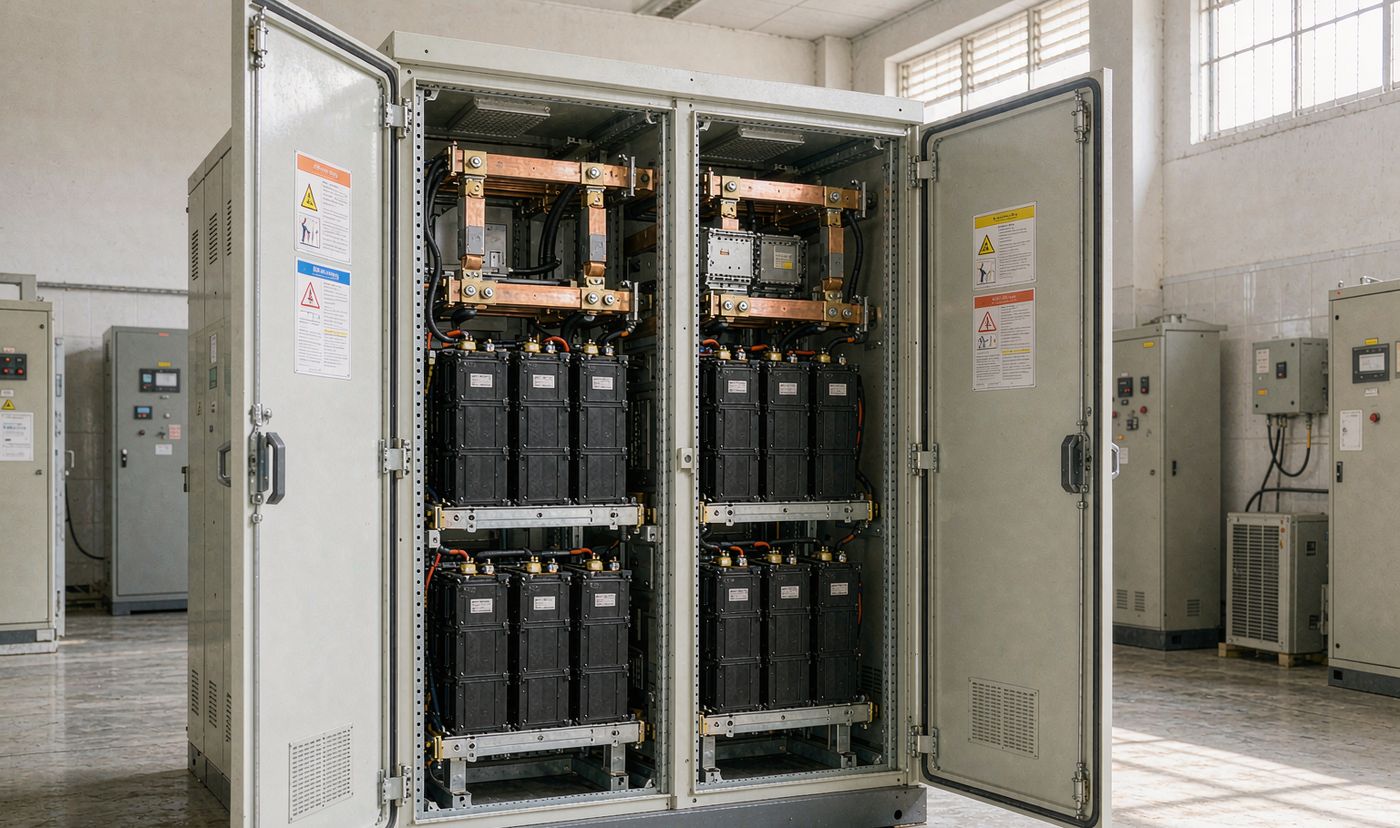
One caution applies to every Nigeria solar band. If your DisCo cannot reliably deliver even the minimum hours for your band, size against observed supply, not against the band definition. Three months of meter readings and generator logs from your own site beat any tariff table, and a supplier who quotes before asking for them is guessing.
What to ask a supplier before you compare quotes
The questions that separate a usable Nigeria solar proposal from a generic one:
- Which band is my feeder on, and which DisCo serves it — EEDC pricing is different.
- What is my measured daily supply, in hours, over the last three months?
- What is my actual diesel consumption per month, and what did it cost?
- On what cycle life and depth of discharge is the cost per delivered kilowatt-hour calculated?
- What is the current SONCAP Product Certificate grade and expiry for these exact models?
That last one is not a formality. SONCAP is a two-tier programme run by the Standards Organisation of Nigeria. Tier one is a Product Certificate registered to the product and manufacturer, and for new energy products PC3 grade adds a factory audit — budget two to four months. Tier two is a Shipment Certificate applied per consignment, issued only after physical inspection at the loading port in China. A container that arrives without a valid Shipment Certificate cannot be regularised at the port, no matter what the duty position is.
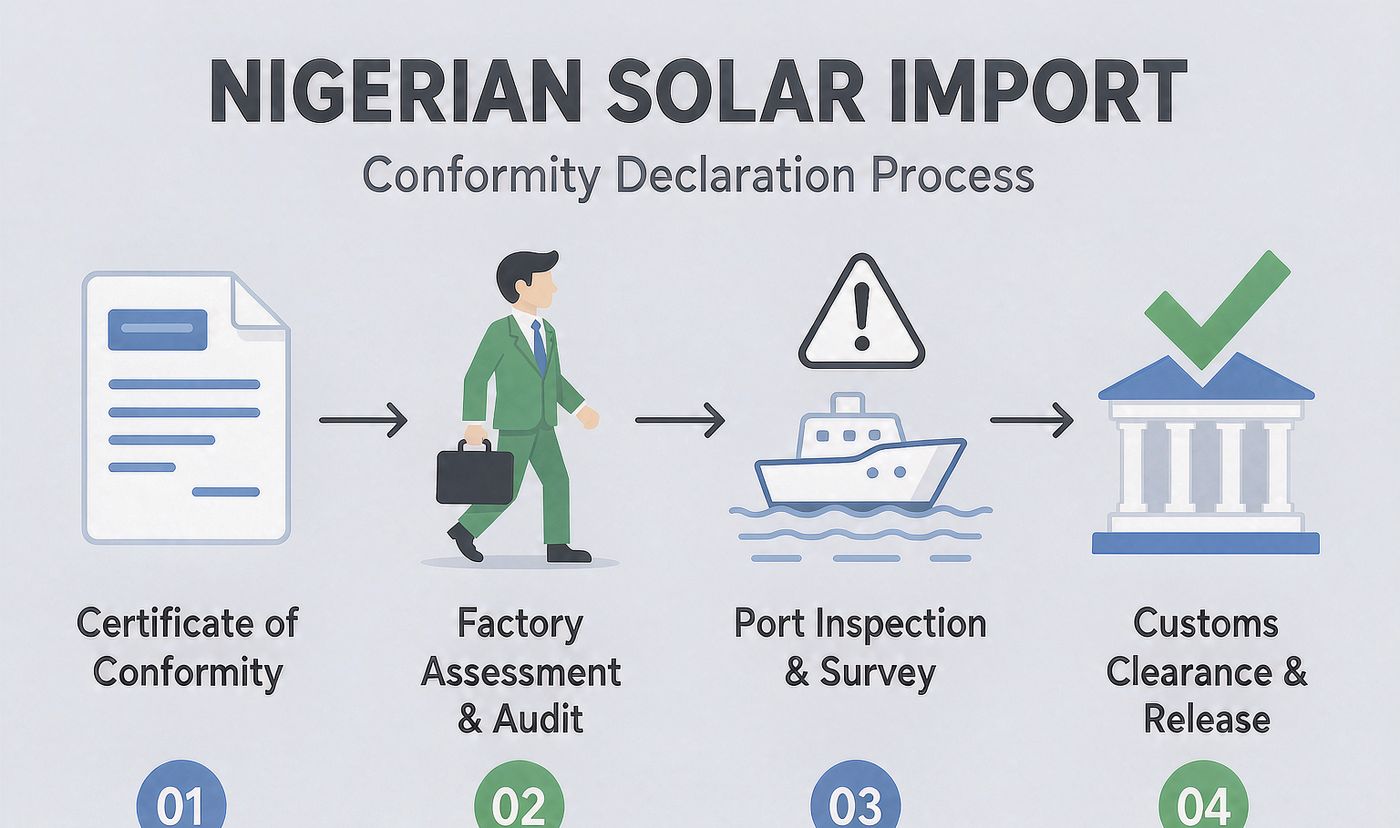
Three assumptions cause most Nigeria solar supply band import problems: that duty exemption removes the SONCAP requirement (it does not — duty and conformity are separate regimes), that it can be arranged after arrival (it cannot, it is pre-shipment), and that a CE declaration is sufficient on its own (IEC reports from an ISO/IEC 17025 accredited laboratory are, a CE declaration alone is not). Form M is mandatory above USD 20,000 and must be opened before shipment.
Frequently asked questions
Is grid power cheaper than running a generator in Nigeria?
On Band A, yes, by roughly half. At ₦209.5/kWh from the grid against about ₦429/kWh for diesel on fuel alone, grid power is about 51 percent cheaper per unit, and the gap widens once generator purchase and maintenance are counted. On lower bands the answer depends on how many hours you actually receive.
Does a lower band mean lower electricity costs for a Nigeria solar buyer?
Usually not. Bands B through E carry lower headline rates — roughly ₦63, ₦50, ₦45 and ₦40 — but also far fewer guaranteed hours. Most commercial sites on those bands run generators for a large share of the day, so their blended cost per kilowatt-hour ends up above the Band A rate.
Is the Band A tariff going up in 2026?
No increase has been approved. The ₦209.5/kWh rate has held since July 2024, the current MYTO order took effect in late 2025, and as of late 2026 the government has signalled no immediate plan to raise it. NERC has put the subsidy cost of the frozen structure at roughly ₦1.928 trillion.
Why is my Band A rate different from ₦209.5?
If your site is served by EEDC, covering Enugu, Anambra, Abia, Imo and Ebonyi, the Band A rate is about ₦160/kWh rather than ₦209.5/kWh. The other ten distribution companies sit at ₦209.5 on Band A. Bands B through E vary by DisCo and no single national figure applies.
How do I size a Nigeria solar battery for a site on Band D or E?
Size against measured supply, not the band definition. On Bands D and E the grid delivers eight to twelve and four to eight hours respectively, so storage has to carry most of the operating day and the generator becomes backup to the battery. Your savings come almost entirely from displaced diesel at roughly ₦429/kWh.
What is the real cost per kWh for a Nigeria solar Band E site?
Work it out from your own split. Band E guarantees four to eight hours, so on a 10,000 kWh month you might get 1,500 kWh from the grid at ₦40 and 8,500 from a generator at ₦429 — a blended rate above ₦370/kWh. That is the number to compare against any solar proposal.
Do I still need SONCAP if solar panels are duty-free in Nigeria?
Yes. Duty and conformity are separate regimes. Photovoltaic modules, inverters, batteries and energy storage systems are all regulated products under SONCAP, and zero duty does not exempt them. Both the Product Certificate and the per-shipment Shipment Certificate are required.
Can I get compensation if my Band A supply falls short?
NERC's Directive NERC/2026/002 provided credits to eligible Band A customers affected by grid generation constraints in February and March 2026, set at 20 percent of the relevant February energy cap or average billed energy depending on customer category. Check with your DisCo for current eligibility, as directives are issued for defined periods.
Ready to price your band?
Send us your DisCo, your feeder band if you know it, and three months of diesel purchases for a Nigeria solar assessment. We will model the blended cost you are actually paying and size storage against it, rather than against a tariff table.
For a Nigeria solar reference point at scale, our 6MW and 20MWh storage deployment in Nigeria displaced enough diesel generation to save more than USD 108,000 a month at a 24-month payback.
About Mars Solar
Mars Solar is a solar system factory in Foshan, China, manufacturing and supplying solar power systems, battery energy storage and street lighting since 2008. We ship Nigeria solar systems to Ghana, Kenya, the Philippines and across the Gulf, the Caribbean and Central America, with SONCAP Product Certificates available on request.
-
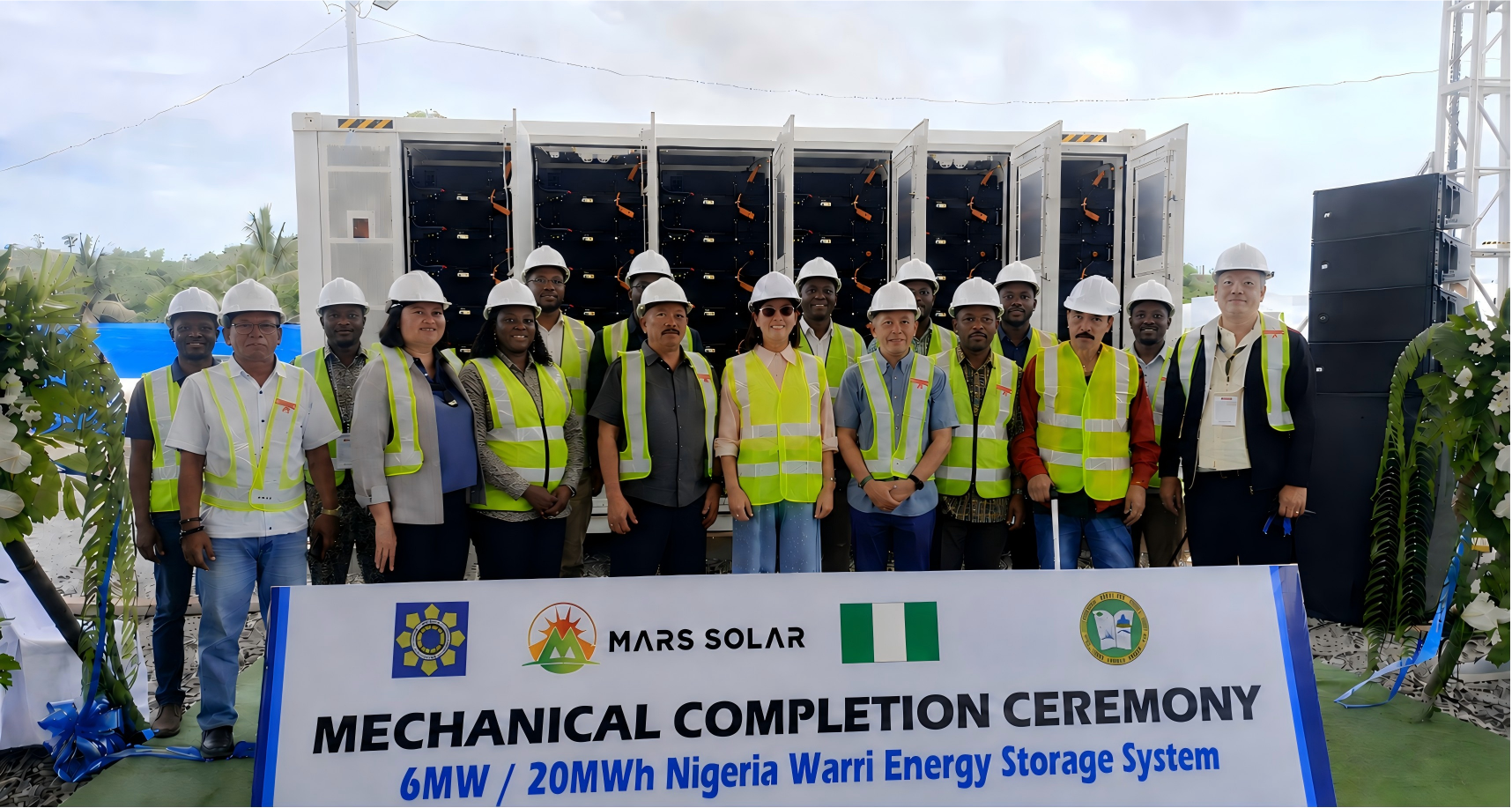 6MW 20MWh Solar Storage in Nigeria Factory + Farm + Residential Case StudyA 6MW solar PV + 20MWh LFP battery storage system in Nigeria powers an integrated factory, farm, and residential complex. The system delivers $108,000+ in monthly electricity savings, reaches payback in approximately 24 months, and provides 25 years of renewable power. This case study covers the engineering configuration, financial model, and operational performance of one of West Africa's most ambitious factory + farm + residential solar deployments.
Do you like ?0
Read more -
Germany's installed capacity demand will reach 11GW and 70GW in 2023As one of the leading countries in the European photovoltaic market, Germany's new installed capacity will reach 11GW in 2023. Looking back at the installed capacity data from January to October 2022, the new installed capacity in German
Do you like ?0
Read more