Solar Panel Selection Guide: Monofacial vs. Bifacial — 2026 Edition
Solar Panel Selection Guide: Monofacial vs. Bifacial — 2026 Edition
15-Parameter Side-by-Side Comparison, 5 Real ROI Case Studies, and 3 Decision Frameworks — Based on 3,000+ Projects Across 130+ Countries
Monofacial and bifacial solar panels look nearly identical from the outside. But pick the wrong one, and your project loses 15–25% of its annual energy output — or pays a 20% premium for a feature that doesn't apply to your site. Drawing on Mars Solar's on-the-ground data from projects across Africa, Southeast Asia, and the Middle East, this guide gives you the objective basis to choose correctly every time.
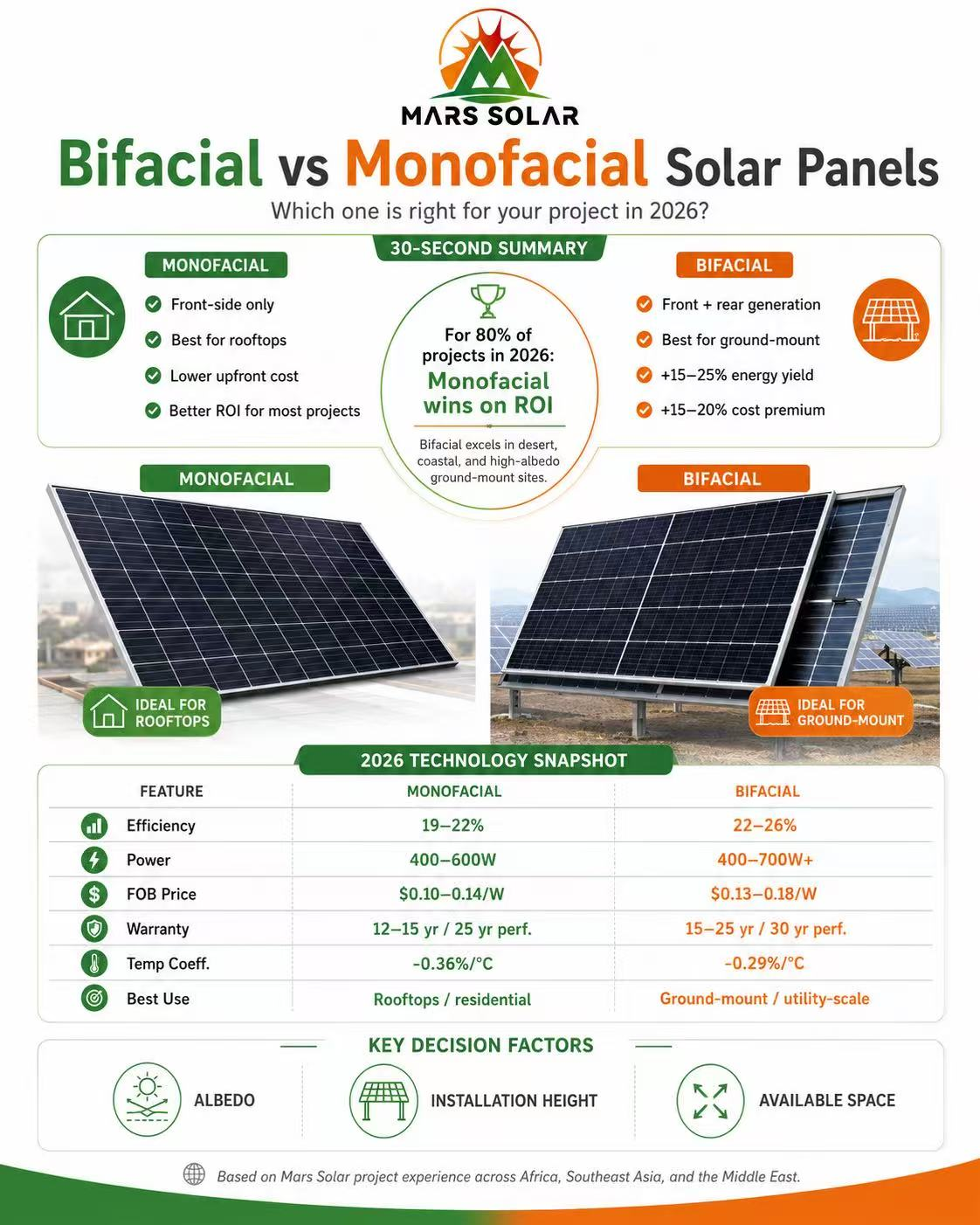
The 30-Second Verdict:
- Bifacial Panels: Generate power from both front and rear surfaces. Ideal for ground-mounted systems, high-albedo surfaces (white concrete, desert, sand), and elevated installations. Output gain: +15–25%. Premium: +15–20%.
- Monofacial Panels: Generate power from front face only. Ideal for rooftops, space-constrained sites, and cost-sensitive projects. Standard pricing, more predictable ROI.
- The 2026 Reality Check: 80% of projects: monofacial delivers better ROI. Utility-scale in desert/coastal regions: bifacial pays off. Core decision factors: Ground Albedo + mounting height + available area.
What's Inside
- How Both Technologies Work
- 15-Parameter Comparison Table
- 4 Scenarios Where Bifacial Wins
- 4 Scenarios Where Monofacial Wins
- 5 Real Project ROI Calculations
- Mars Solar 2026 Module Selection Guide
- FAQ
I. How the Two Technologies Work
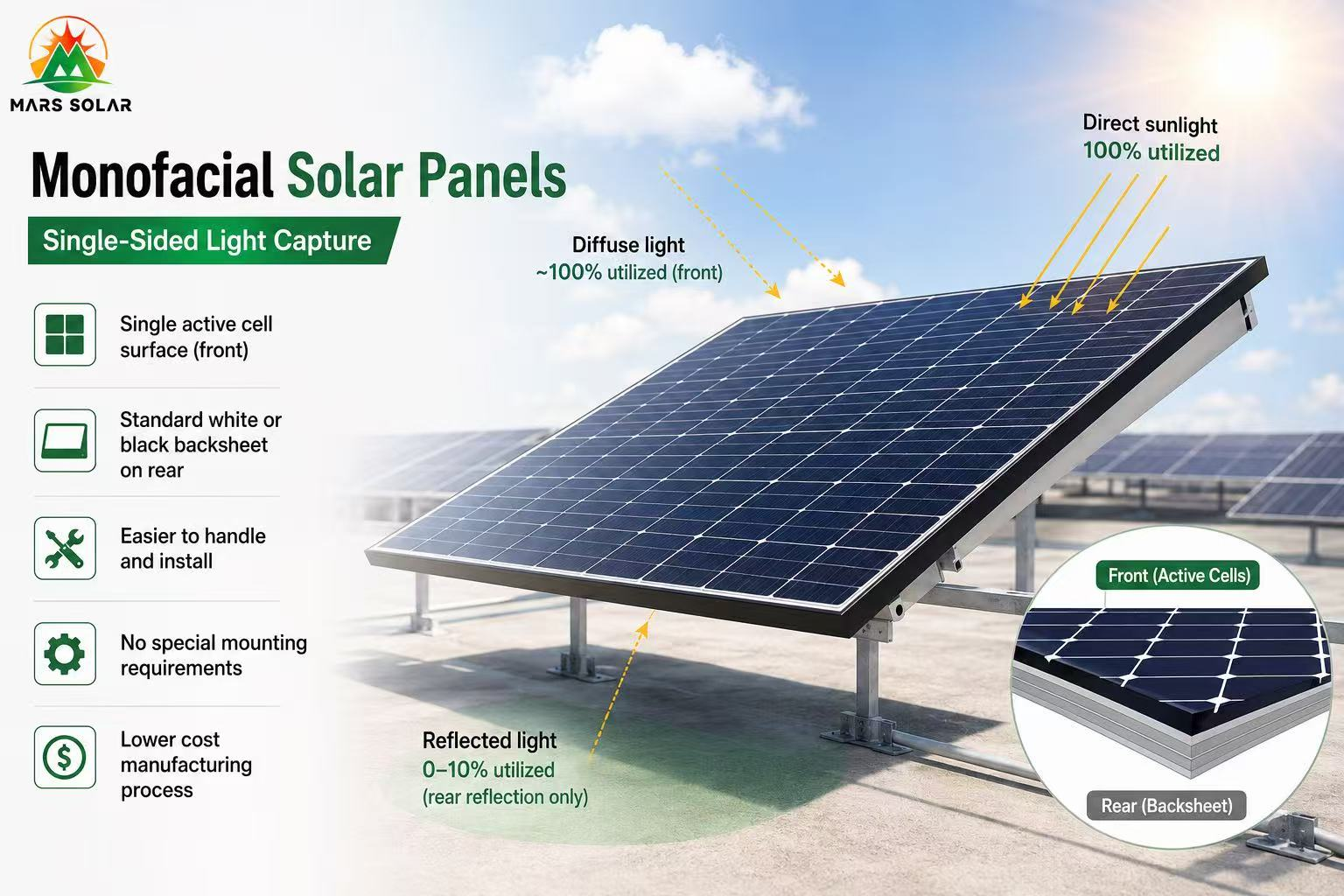
Monofacial Panels — Front Face Only
- Solar cells on front side only; rear side is opaque backheet (white or black)
- Standard white or black backheet; rear contributes virtually no power
- Easy installation, no special mounting requirements
- Lower manufacturing cost, stable pricing
- Direct sunlight: 100% utilized (front)
- Diffuse light (overcast): ~100% utilized (front)
- Ground-reflected light: 0–10% (only minimal rear reflection)
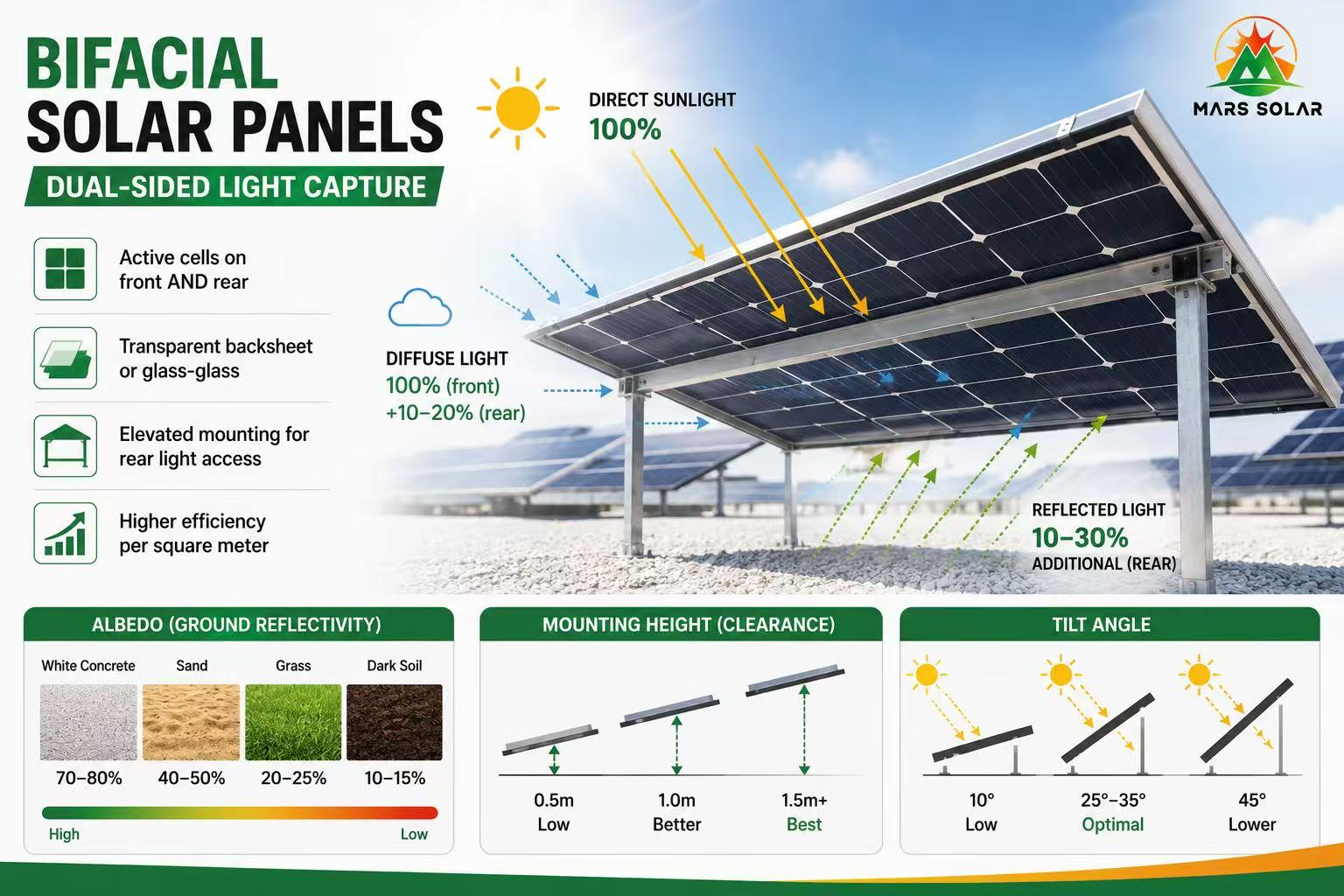
Bifacial Panels — Front and Rear Simultaneously
- Both front and rear surfaces contain active solar cells
- Transparent backheet or glass-glass (double-glass) construction
- Requires elevated or open-rack mounting to allow rear illumination
- Higher power density per unit area
- Direct sunlight: 100% (front)
- Diffuse light: 100% (front) + 10–20% (rear)
- Ground-reflected light (Albedo): additional 10–30% energy gain
⚡ Three Key Variables That Drive Bifacial Gain:
- Ground Albedo (Reflectivity): White concrete 70–80%, sand 40–50%, grass 20–25%, dark soil 10–15%
- Mounting Height: The higher the panels are mounted, the more light reaches the rear
- Tilt Angle: Optimal tilt maximizes rear-side irradiance
II. 15-Parameter Side-by-Side Comparison
|
|
|
|
|
Parameter |
Monofacial |
Bifacial |
|
Active Light-Capturing Surface |
Front only |
Front + rear |
|
Typical Backsheet |
White/black opaque backsheet |
Transparent backsheet or glass-glass |
|
Structural Strength |
Standard |
Glass-glass version significantly stronger |
|
Power Density per Area |
Standard (550–600W/m²) |
5–15% higher (more power per square meter) |
|
Installation Requirements |
None special |
Requires elevated or open-rack mounting |
|
Suitable Mounting Types |
Rooftop, ground, BIPV |
Ground-mount optimal; rooftop gain limited |
|
Direct Light Utilization |
100% |
100% (front) |
|
Diffuse Light Utilization |
~100% |
100% (front) + 10–20% (rear) |
|
Ground-Reflected Light Gain |
0–10% |
+10–30% |
|
High-Temperature Performance |
Standard temp coefficient |
N-Type TOPCon bifacial has better temp coefficient (−0.29%/°C) |
|
Best Suited Climates |
All-purpose |
Desert/snow/high-albedo regions — peak performance |
|
Typical FOB China Price |
$0.10–0.14/W |
$0.12–0.17/W (15–20% premium) |
|
Best Project Scale |
1kW–10MW+ |
50kW–10MW+ utility-scale optimal |
|
Key Suppliers |
Jinko/LONGi/Trina/JA/Mars Solar |
LONGi/Trina/Risen/Mars Solar |
III. Four Scenarios Where Bifacial Is the Right Choice
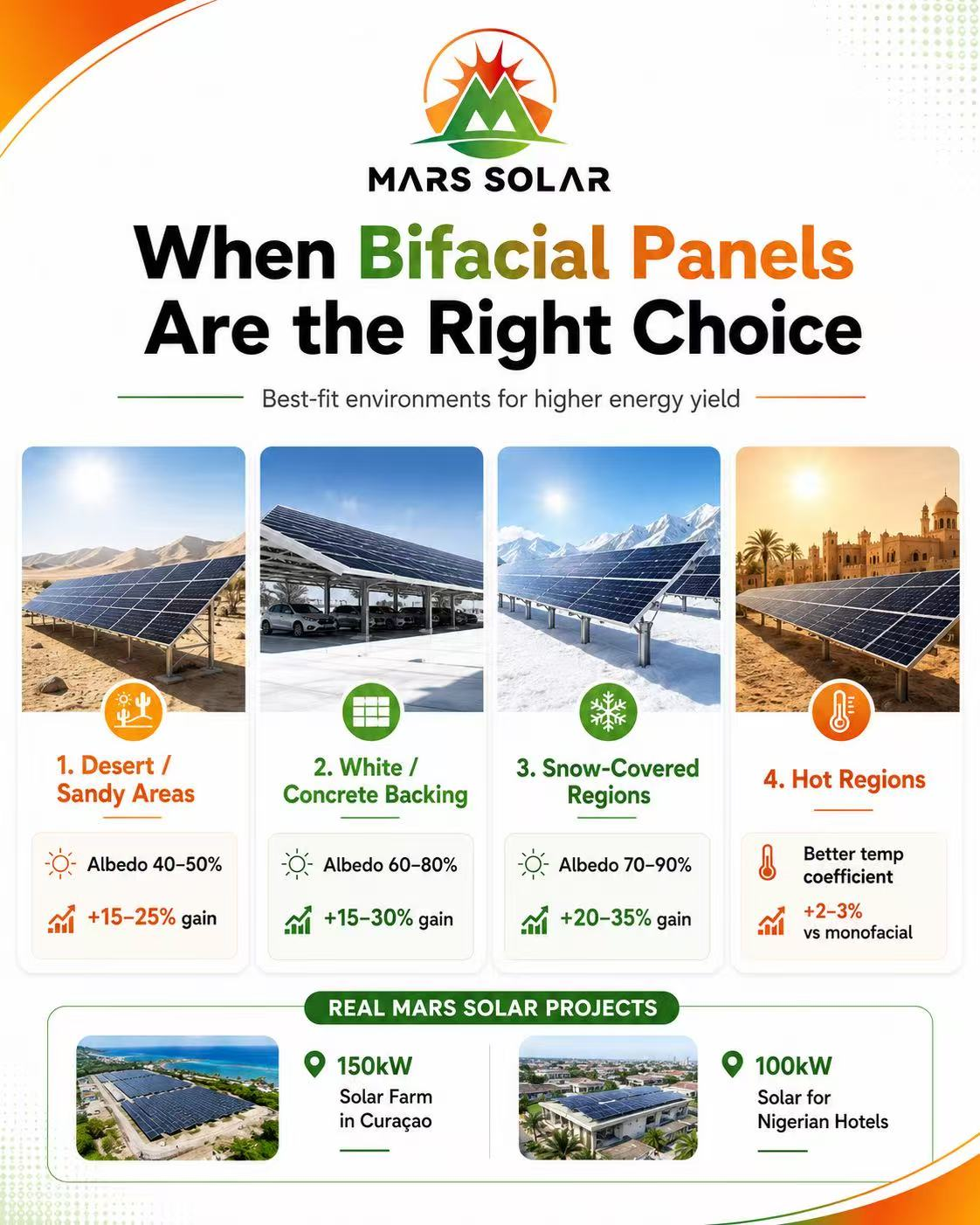
1. Scenario A: Desert/Sandy Ground-Mounted Plants
Power gain: Albedo 40–50% (sand reflectivity), bifacial gain +15–25%
Real case: UAE 500kW ground-mounted bifacial plant, additional 75–125 MWh/year, payback on premium in 2–3 years
2. Scenario B: White Concrete / Gravel Ground
Power gain: Albedo 60–80% (white concrete, parking lots), bifacial gain +15–30%
Best for: concrete-base solar farms, carport canopies (pv parking)
3. Scenario C: Snow-Covered Regions
Power gain: Albedo 70–90% (fresh snow), winter bifacial gain +20–35%
Ideal for: Nordic countries, Canada, northern Russia, and other high-latitude projects
4. Scenario D: Hot Climates (Africa, Middle East)
Power gain: N-Type TOPCon bifacial has better temp coefficient (−0.29%/°C vs −0.36%/°C monofacial PERC)
At 40°C, bifacial N-Type TOPCon generates 2–3% more power per degree above STC. The top choice for UAE, Saudi Arabia, and Nigeria.
Mars Solar Bifacial Project Examples:
- 150kW Solar Farm in Curaçao — elevated bifacial on white coral ground
- 100kW Nigerian Hotel — commercial rooftop hybrid approach
IV. Four Scenarios Where Monofacial Is the Right Choice
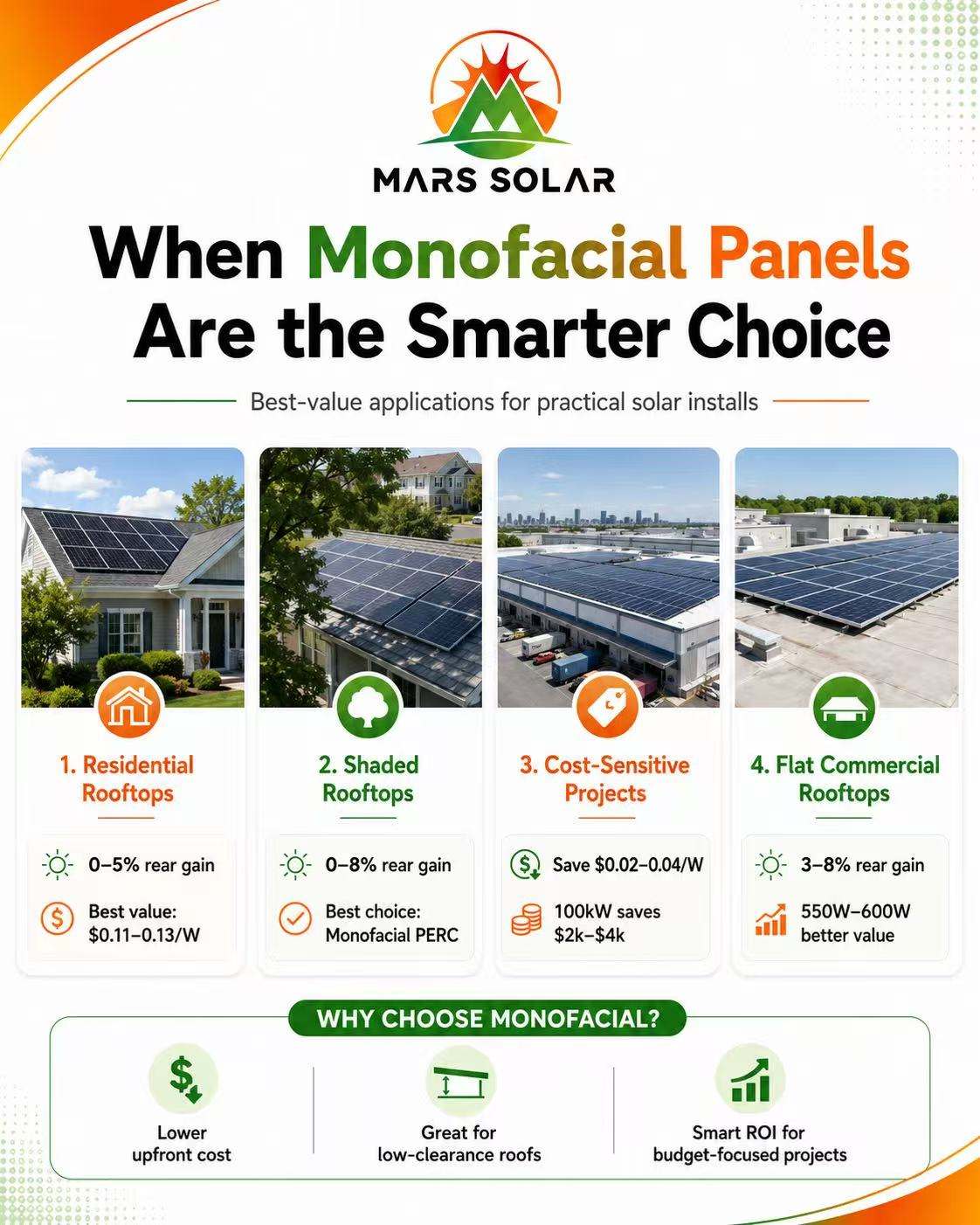
1. Scenario A: Residential Rooftops (Any Region)
Limited mounting height; panels sit flush against roof tiles, leaving almost no rear light path. Bifacial gain: 0–5%. The premium is not justified.
✅ Conclusion: $0.11–0.13/W monocrystalline PERC is always the right choice
2. Scenario B: Partially Shaded or Obstructed Rooftops
Surrounding buildings or trees reduce albedo; bifacial gain drops to 0–8%. The extra premium is not earned back.
✅ Conclusion: Standard monocrystalline PERC
3. Scenario C: Budget-Sensitive Projects
Bifacial premium adds $0.02–0.04/W; on a 100kW project that's $2,000–4,000 extra. If the site albedo doesn't justify it, that money is better spent on battery expansion.
✅ Conclusion: Monofacial is the right call when budget is tight
4. Scenario D: Flat Commercial Rooftops Without Sufficient Clearance
Flat industrial roofs often lack enough headroom for elevated racking; bifacial gain drops to 3–8%. Better to spec high-wattage monocrystalline PERC 550W–600W for maximum power density per square meter.
✅ Conclusion: High-wattage monocrystalline PERC delivers better value
V. Five Real Project ROI Calculations
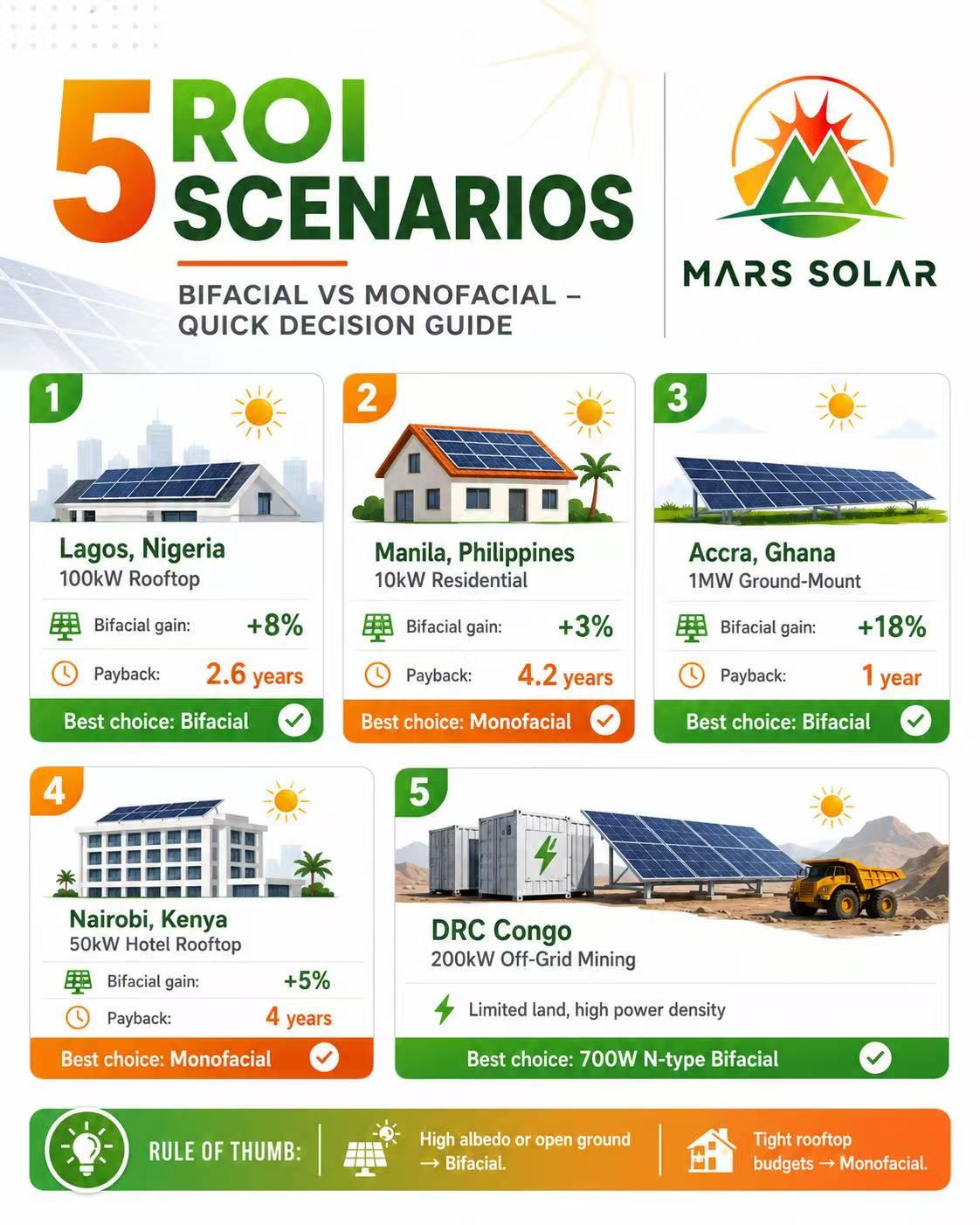
Project 1: 100kW Commercial Rooftop in Lagos, Nigeria
• Site: Concrete flat roof, Albedo ~25%
• Monofacial option: Monofacial: 550W × 182 panels = 100.1kW, cost $12,000
• Bifacial option: Bifacial: 600W × 167 panels = 100.2kW, cost $14,500 (+$2,500)
• Gain & payback: Bifacial gain: +8% = +8 MWh/year, annual revenue $960 (at $0.12/kWh), payback: 2.6 years
Verdict: ✅ Bifacial pays off
Project 2: 10kW Residential Rooftop in Manila, Philippines
• Site: Sloped tile roof, no elevated space, Albedo ~10%
• Monofacial option: Monofacial: $1,200; Bifacial: $1,580 (+$380)
• Bifacial option: Bifacial: $1,580 (+$380)
• Gain & payback: Bifacial gain: +3% = +0.3 MWh/year, annual revenue $90 (at ₱10/kWh), payback: 4.2 years (marginal)
Verdict: Conclusion: Monofacial ✅
Project 3: 1MW Ground-Mounted Plant in Accra, Ghana
• Site: Gravel ground base, Albedo ~40%
• Monofacial option: Monofacial: $130,000; Bifacial: $148,000 (+$18,000)
• Bifacial option: Bifacial: $148,000 (+$18,000)
• Gain & payback: Bifacial gain: +18% = +180 MWh/year, annual revenue $18,000 (at $0.10/kWh), payback: 1 year
Verdict: ✅ Bifacial is excellent
Project 4: 50kW Hotel Rooftop in Nairobi, Kenya
• Site: Corrugated metal roof, Albedo ~15%
• Monofacial option: Monofacial: $6,500; Bifacial: $7,800 (+$1,300)
• Bifacial option: Bifacial: $7,800 (+$1,300)
• Gain & payback: Bifacial gain: +5%, annual revenue $325, payback: 4 years
Verdict: Conclusion: Monofacial high-wattage 580W PERC ✅
Project 5: 200kW Off-Grid Mining Camp in DRC
• Site: Red soil surface, Albedo ~12%, space-constrained, need maximum power density
• Monofacial option: Key objective: maximize power per square meter (space is the constraint)
• Bifacial option: Choice: High-power bifacial N-Type TOPCon 700W — space density beats low albedo
• Gain & payback: Bifacial gain: marginal, but space savings critical
Verdict: Conclusion: Bifacial high-density choice correct for this specific scenario ✅
VI. Mars Solar 2026 Module Selection Guide — By Project Type
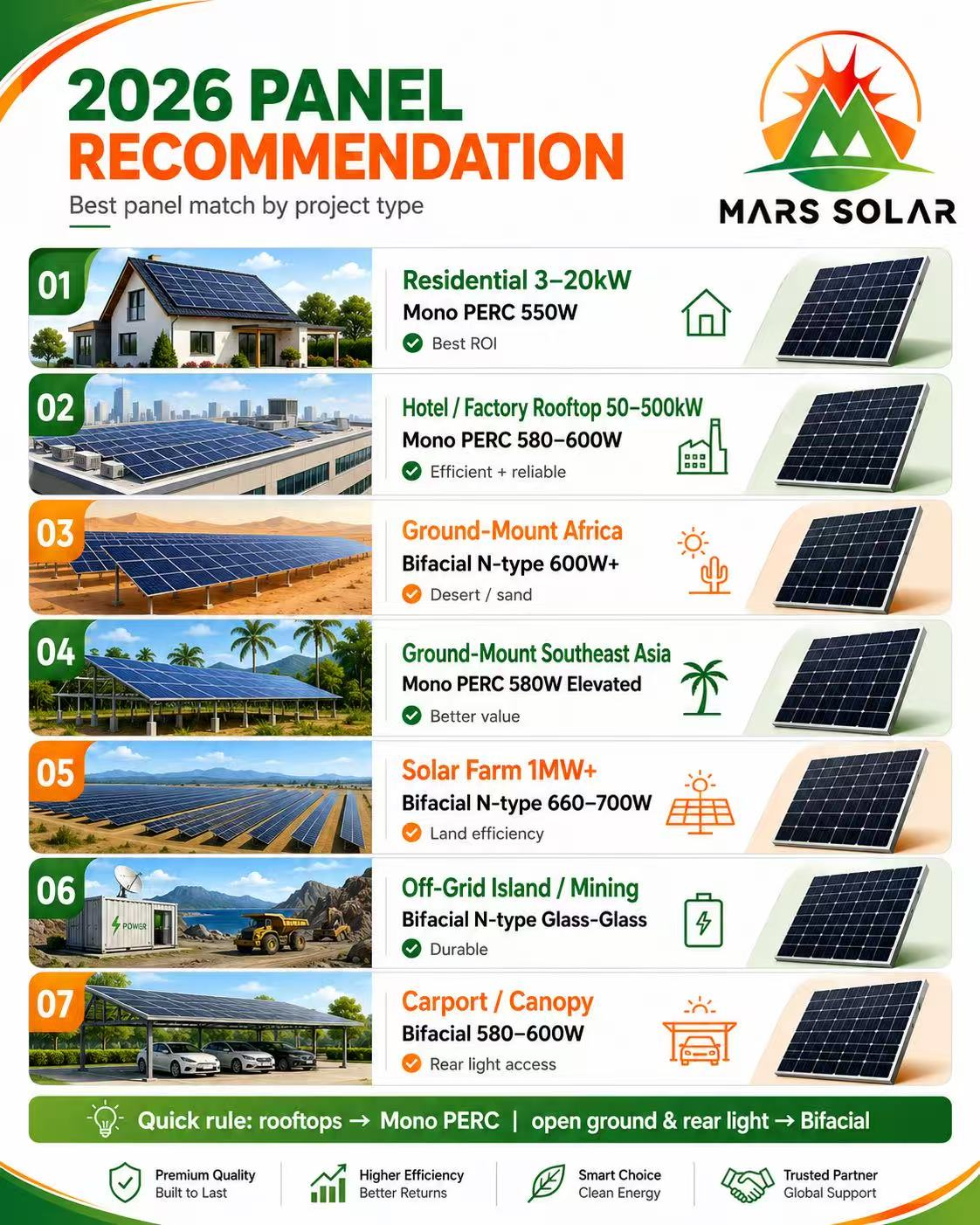
- Residential Rooftops (Global): High-power monocrystalline PERC 550W–580W — best value
- Commercial Concrete Flat Roofs (Albedo 40%+): Bifacial N-Type TOPCon 600W–700W — premium pays back in 2–3 years
- Industrial Factory Rooftops (Low Albedo): High-power monocrystalline PERC 580W–600W — don't pay for bifacial
- Utility-Scale Ground-Mount (Desert/High-Albedo): Bifacial N-Type TOPCon 660W–700W — worth every dollar
- Snowy/High-Latitude Regions: Glass-glass bifacial structure — winter output significantly boosted by high albedo
- Off-Grid / Mining Projects (Space-Constrained): High-density bifacial N-Type TOPCon 700W — maximum power per square meter
VII. Frequently Asked Questions
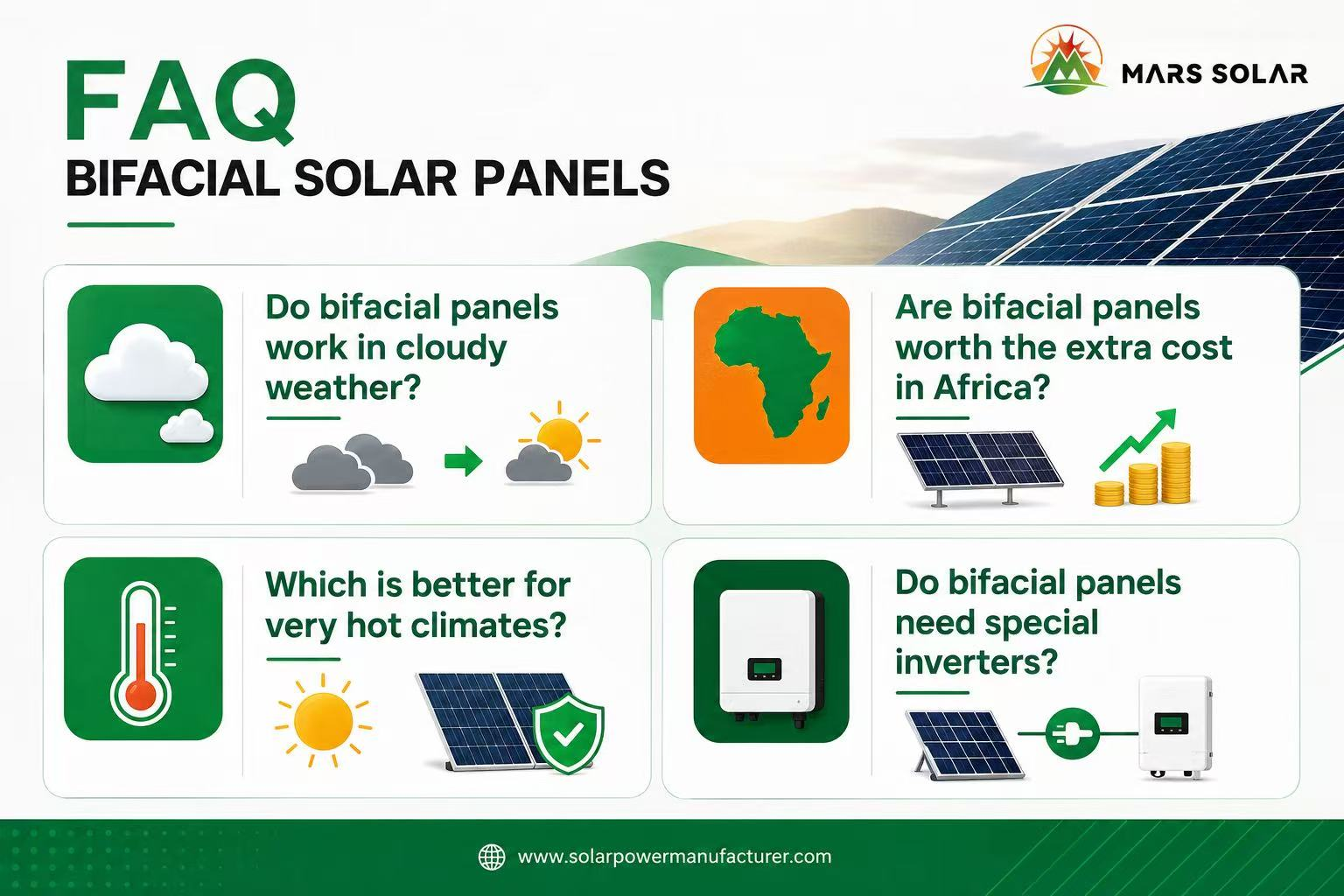
Q: How do bifacial panels perform on cloudy days?
A: They still work, but the gain shrinks. Cloudy skies are dominated by diffuse light, which reduces the bifacial advantage from 15–25% (sunny days) to 5–10%. In persistently overcast regions like the UK or Nordic countries, the bifacial premium is hard to recoup.
Q: Are bifacial panels suitable for African projects?
A: For ground-mounted utility-scale: strongly YES. The Sahara and sub-Saharan sand has 40–50% albedo, and a 15–25% bifacial gain is well-supported by field data. For African rooftop projects: usually NO (mounting height is limited and dark roofs have low albedo).
Q: Which type is better for hot climates?
A: N-Type TOPCon bifacial has a better temperature coefficient (−0.29%/°C vs. monocrystalline PERC −0.36%/°C). In regions above 35°C (UAE, Saudi Arabia, Nigeria), N-Type bifacial generates 2–3% more power per degree above STC compared to monofacial — making it the top choice for hot-climate projects.
Q: Do bifacial panels require a special inverter?
A: No. Bifacial panels have the same DC input specifications as monofacial panels and work with any standard inverter.
Q: Is the installation cost higher for bifacial panels?
A: Yes — mainly in racking (they need to be elevated to allow rear illumination) and labor (more complex installation). But if the site albedo is high enough, these extra costs are typically recovered within 1–3 years through additional energy generation.
Not Sure Which Type to Choose? Let Mars Solar's Engineers Help
Mars Solar's 30+ in-house engineers can provide optimal panel type recommendations for your specific project. We supply both monocrystalline PERC and bifacial N-Type TOPCon — and we only recommend the option with the highest ROI for your site, not the one with the highest margin.
Get a Free Module Selection Recommendation:
- Tell us your project: location, size (kW), mounting surface type, and budget
- Engineer responds with technical recommendation within 24 hours
- FOB/CIF/DDP pricing provided for all Incoterms options
Contact Mars Solar:
- WhatsApp: +86-15302966051
- Email: [email protected]
- Website: solarpowermanufacturer.com (free quote)
-
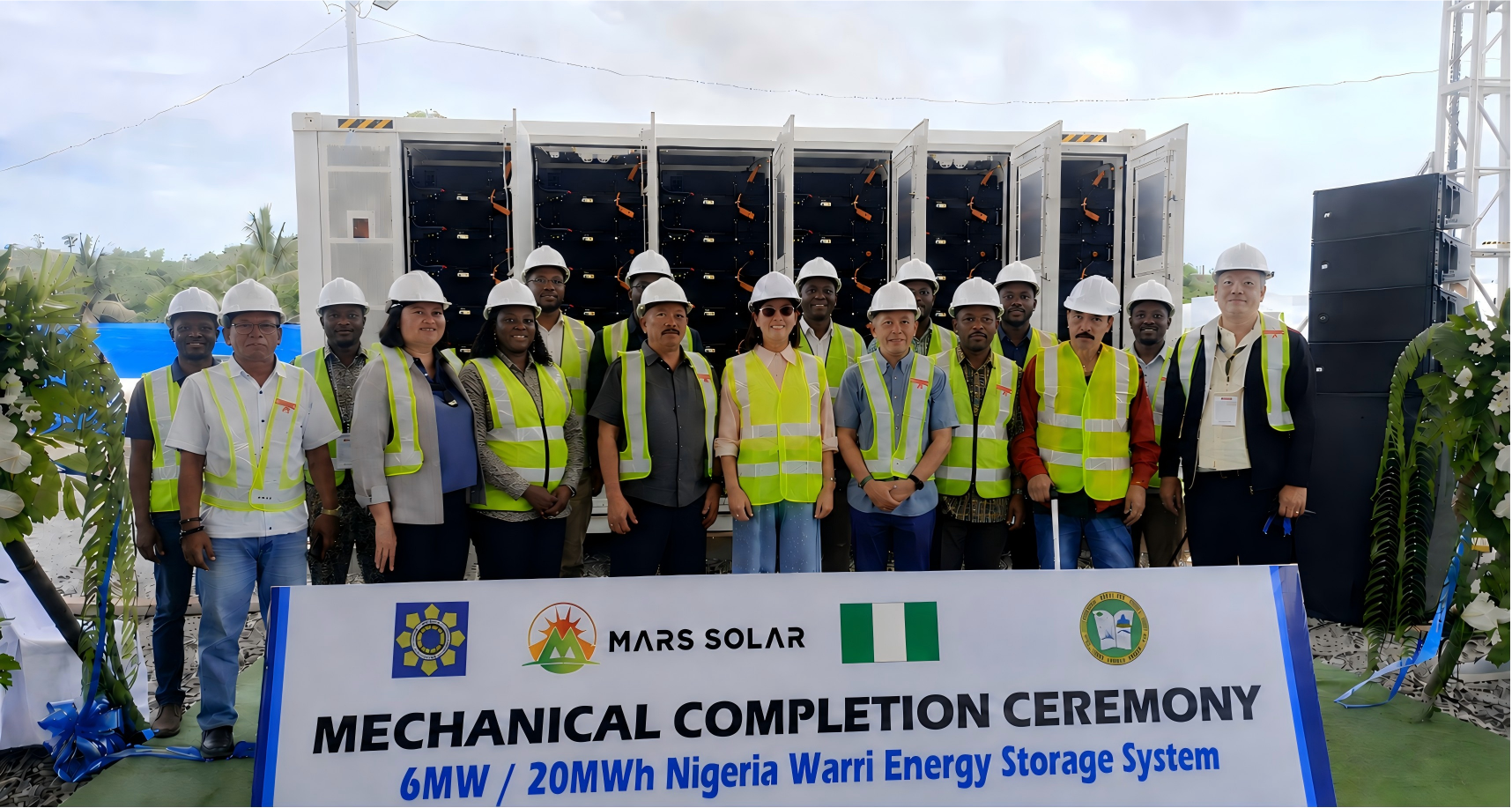 6MW 20MWh Solar Storage in Nigeria Factory + Farm + Residential Case StudyA 6MW solar PV + 20MWh LFP battery storage system in Nigeria powers an integrated factory, farm, and residential complex. The system delivers $108,000+ in monthly electricity savings, reaches payback in approximately 24 months, and provides 25 years of renewable power. This case study covers the engineering configuration, financial model, and operational performance of one of West Africa's most ambitious factory + farm + residential solar deployments.
Do you like ?0
Read more -
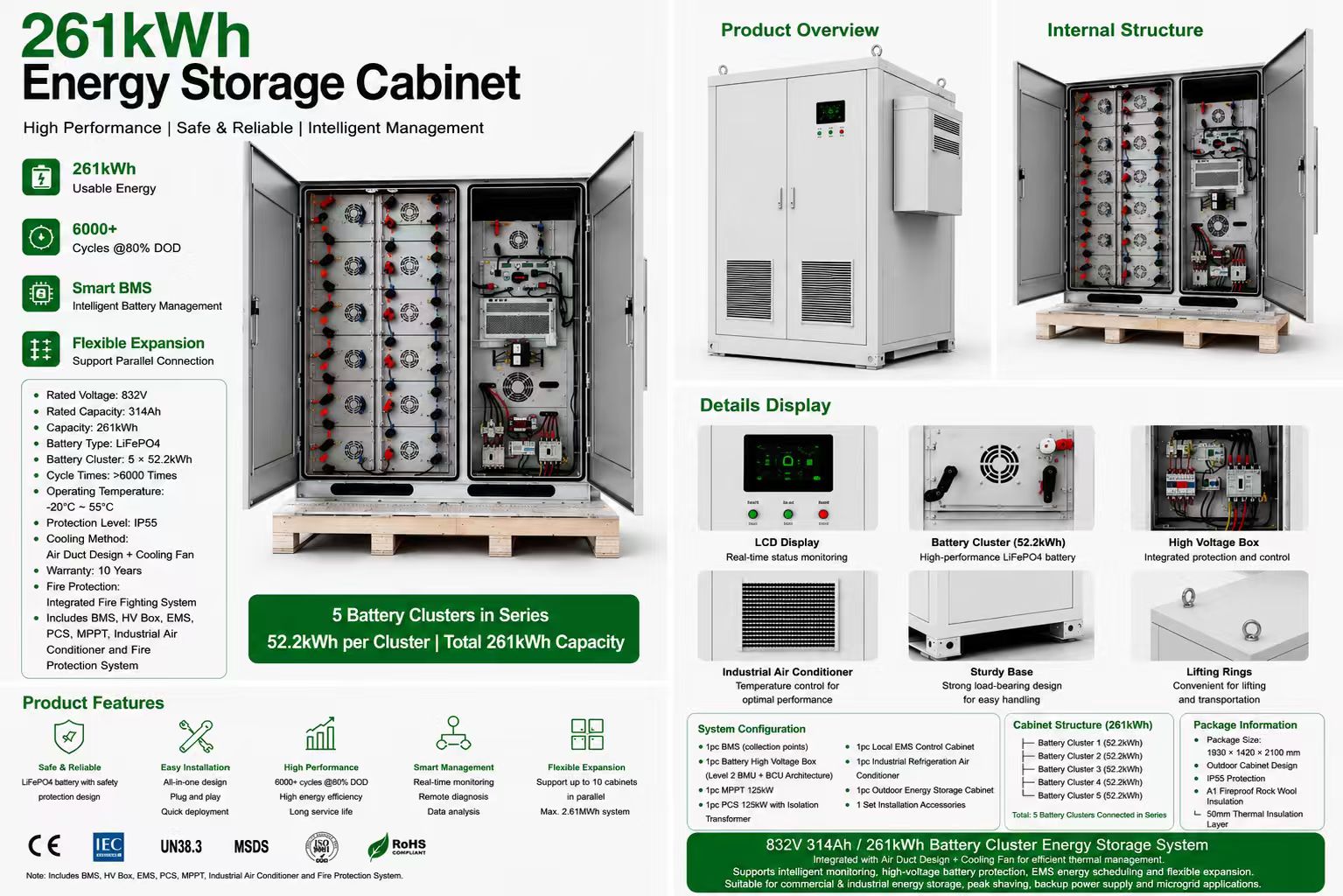 BESS in Nigeria 2026: Battery Energy Storage Cost, Diesel Payback & Import GuideBESS in Nigeria: 2026 pricing, diesel payback, SONCAP, China import guide. Save 60%+ vs diesel. Factory-direct LFP from Mars Solar.
Do you like ?0
Read more -
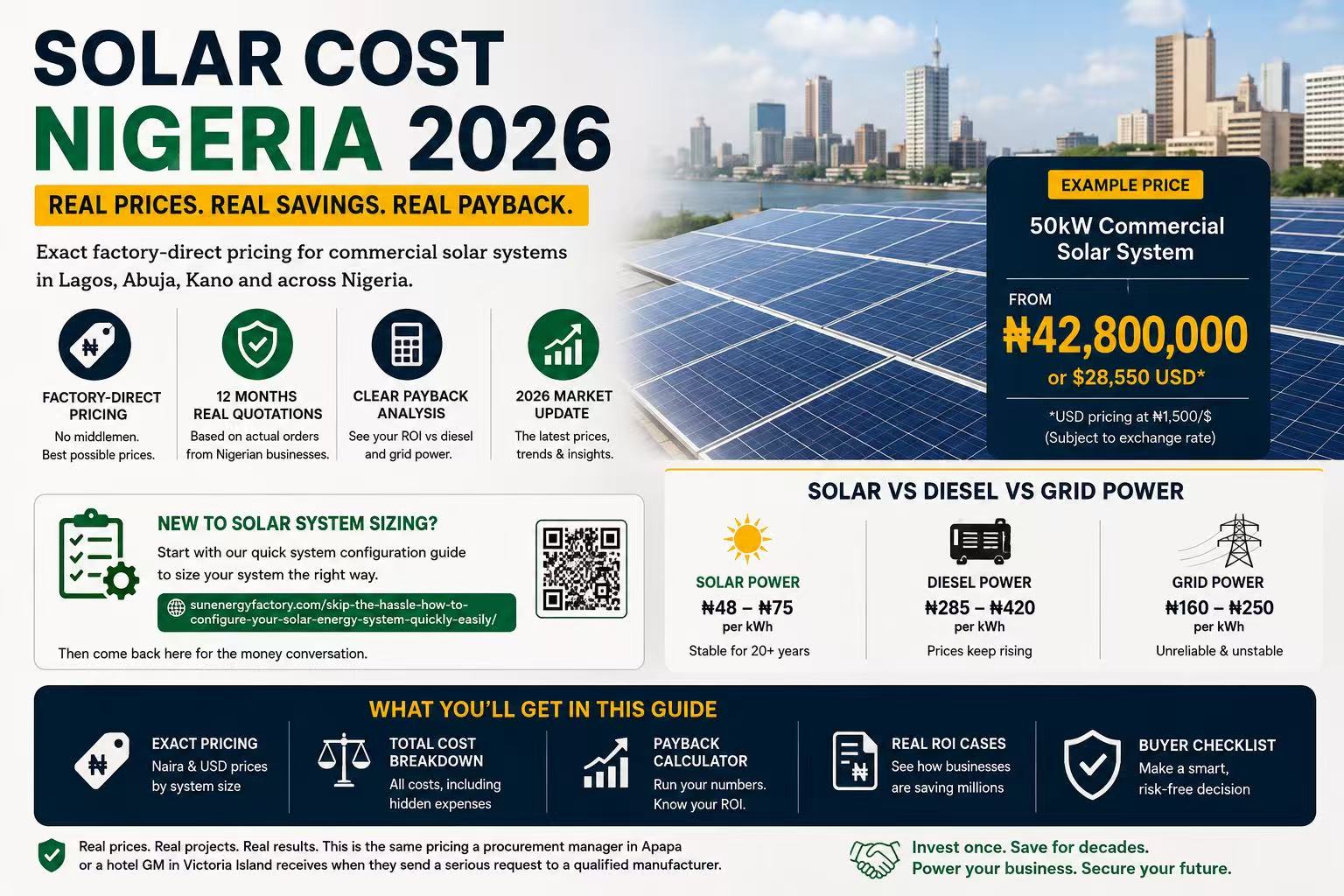 How Much Does Solar Cost in Nigeria? 2026 Real Pricing GuideSolar cost in Nigeria for 5kW to 250kW systems, in Naira and USD. Compare solar vs diesel vs grid, calculate payback, and explore financing options.
Do you like ?0
Read more -
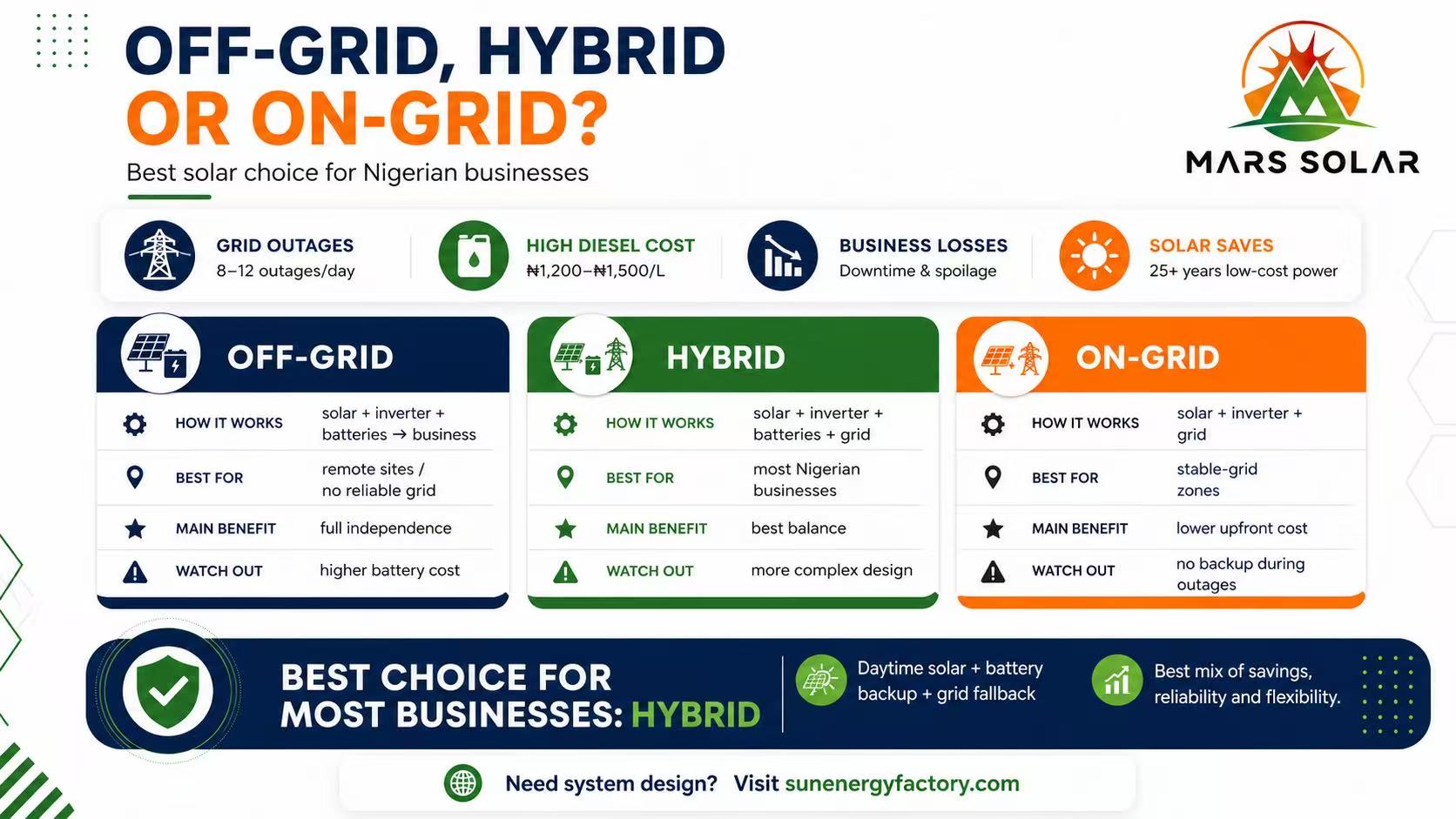 Solar Power Nigeria 2026: Off-Grid vs Hybrid vs On-GridNigeria’s unreliable grid and soaring diesel costs are forcing business owners to take solar seriously. But the biggest question remains: which system — off-grid, hybrid, or on-grid? This 2026 guide breaks down all three solar architectures for Nigeria
Do you like ?0
Read more -
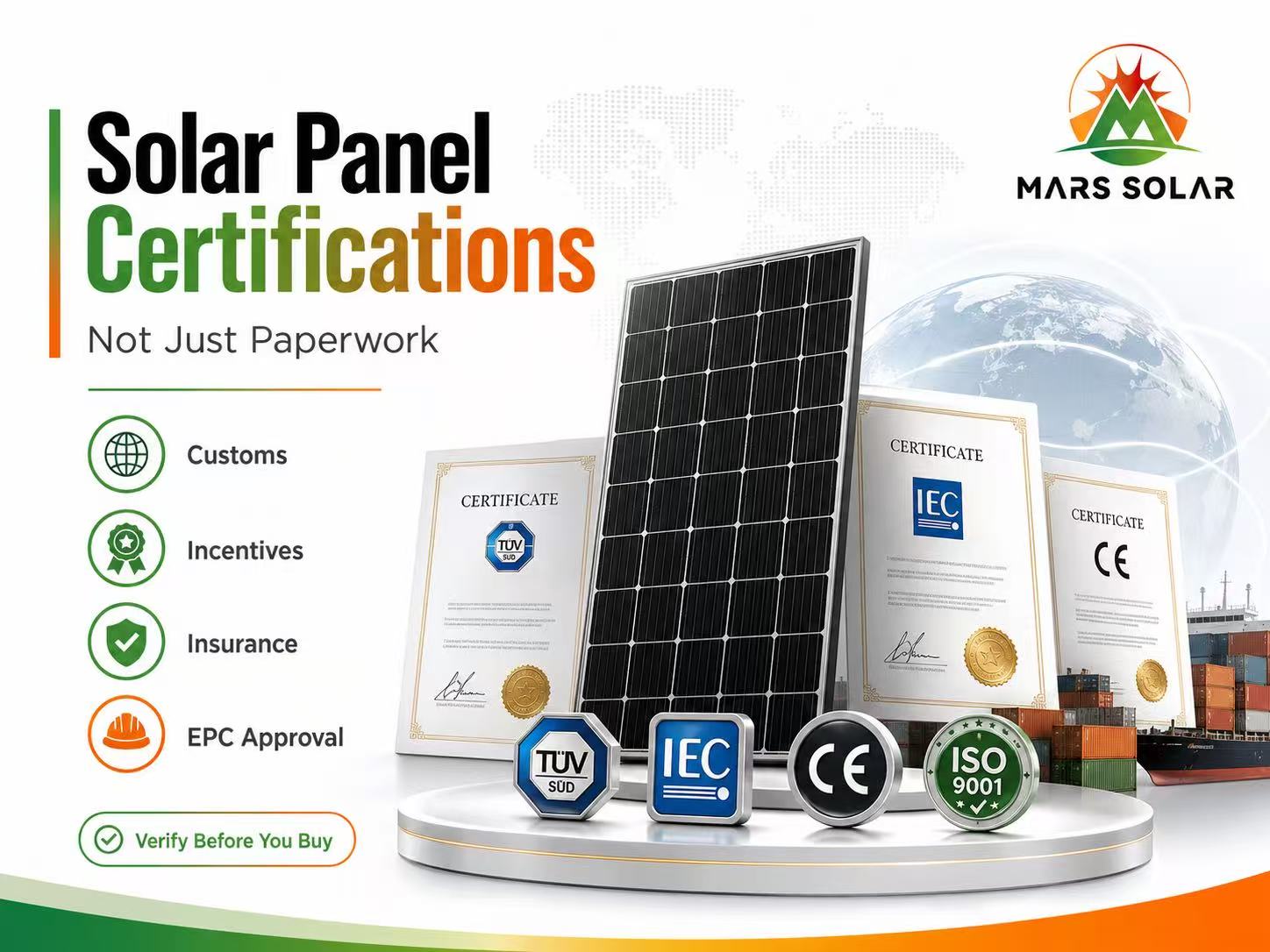 Solar Panel Certifications Explained: IEC, UL, TÜV, CE, ISO — The 2026 GuideA solar panel without proper certifications is unsellable in 90% of international markets. This 2026 guide explains every major certification — IEC 61215, IEC 61730, UL 61730, TÜV, CE, ISO 9001/14001/45001 — what it tests, who issues it, which markets req
Do you like ?0
Read more -
 Solar Panel Shipping & Container Loading: The 2026 Complete GuideThe solar panels leaving the factory are perfect. By the time they arrive at your warehouse, 3–7% might be damaged, delivery could be 2 weeks late, and demurrage at the destination port could wipe out your margin. This 2026 guide covers container types (2
Do you like ?0
Read more